Second opinion on spine MRI and CT
An independent read of your spine MRI or CT — for a herniated disc, back pain, spinal stenosis, or before surgery. Written by experienced German radiologists, usually within 48 hours.


Spine MRI and CT
A spine MRI or CT almost always leaves questions behind: What does the report actually mean? How sure is it? And does the next step someone proposed really follow from it? With a herniated disc, persistent back pain or spinal stenosis, getting an independent second opinion is a well-established step.
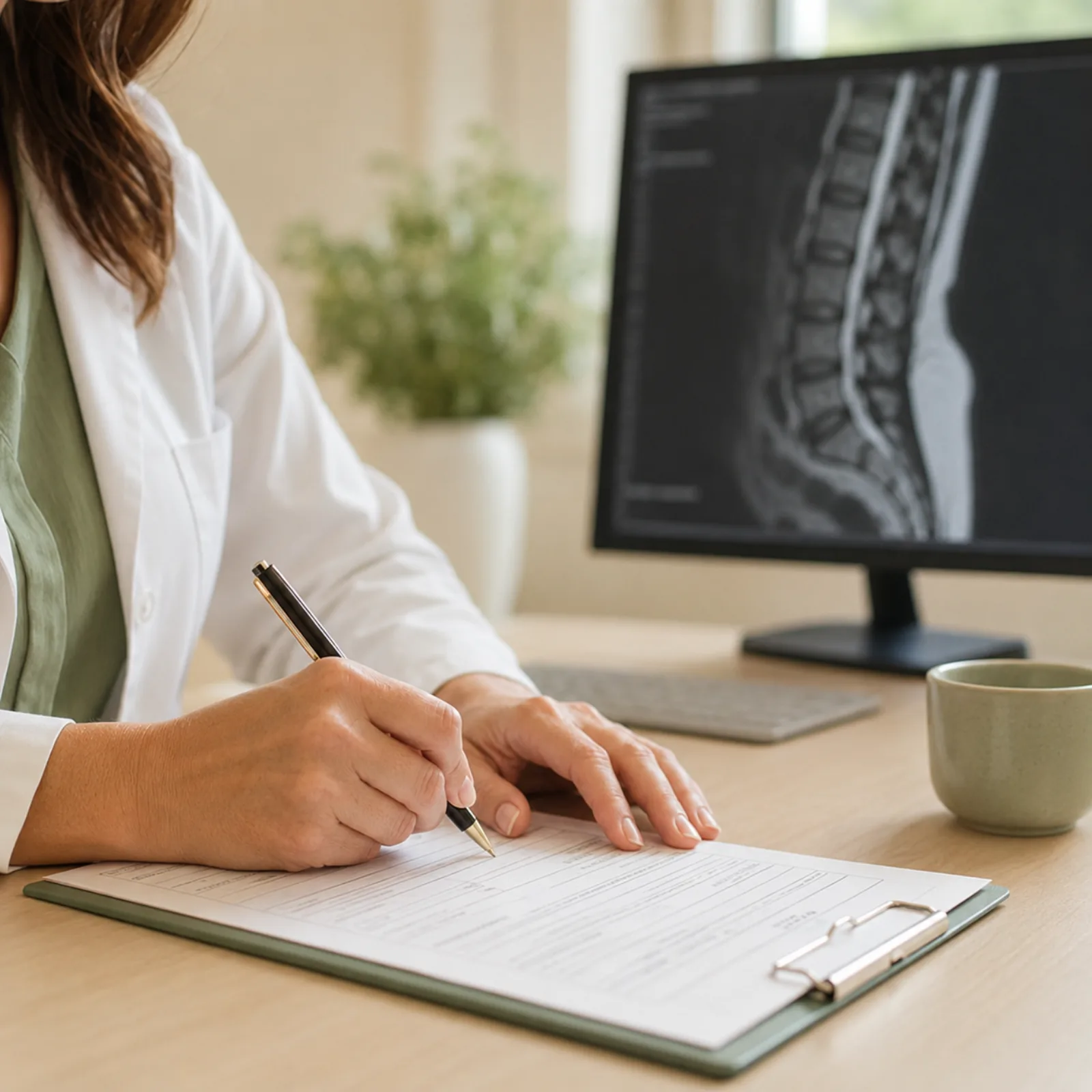
Radiological second opinions are all we do. You send us your MRI or CT images of the lumbar, thoracic or cervical spine; an experienced board-certified radiologist reviews the original images from scratch — and you usually have a clear written answer within 48 hours.
Read by specialists in spine imaging
A second opinion is only as good as the person who writes it. The spine is anatomically crowded — discs, vertebral bodies, facet joints, ligaments, nerve roots and the spinal cord all sit close together, and many important findings are subtle.
At Second View, your images are read by board-certified radiologists licensed in Germany with experience in musculoskeletal and neuroradiological imaging. They take the time to work through every sequence systematically, rather than simply confirming the first report.
Submit your imagesWhen a second opinion is worth it
A second read of your imaging is especially useful when:
- you have been told you have a herniated disc (protrusion, extrusion or sequestration) and want to know how severe it really is;
- you have back pain and the report never names a clear cause;
- your doctors are weighing spinal stenosis or foraminal narrowing, where the nerves exit the spine;
- someone has recommended spine surgery and you want to understand what that recommendation rests on;
- the report is short and does not match how you actually feel;
- you simply want a second, independent opinion before you decide.
How it works
- Upload your images. Send us your original images (DICOM) along with the report you already have — from a CD, a USB stick or your patient portal.
- A specialist reads them. A radiologist experienced in musculoskeletal and neuroradiological imaging reviews your original images independently.
- You get a written second opinion. A clearly worded written assessment, usually within 48 hours.
What it costs
A radiological second opinion from Second View costs €70 to €200, depending on the type and complexity of the exam. You see the price before you order — there are no hidden fees.
Privately insured in Germany? Private health insurance often reimburses the cost of a medical second opinion. Keep the invoice so you can submit it.
Submit your images


Common terms in a spine MRI or CT report
Spine reports are full of jargon. Knowing what the words mean is no substitute for a medical opinion, but it does help you walk into the next appointment better prepared:
- Protrusion / extrusion / sequestration: the stages of a herniated disc — from a bulging disc (protrusion), to one that has broken through (extrusion), to a fragment that has broken off entirely (sequestration).
- Annular tear: a fine tear in the tough outer ring of the disc. It can cause pain and is easy to overlook in a short report.
- Spinal stenosis: narrowing of the spinal canal, which carries the spinal cord and nerve roots.
- Neuroforaminal stenosis: narrowing of the side channel where a nerve exits the spine — a common cause of pain that radiates into an arm or leg.
- Spondylolisthesis: one vertebra has slipped forward relative to the one below it — the finding that matters most for questions of instability.
- Facet joint arthritis or irritation: wear and tear in the small joints at the back of the spine — an underrated source of pain.
- Bone marrow edema (bone bruise): fluid in the bone, often after an injury — an important clue that something happened recently.
- Modic changes / Pfirrmann grade: standardized scales for changes at the vertebral endplates and for disc degeneration.
Frequently asked questions
How does the second opinion work?
You fill in a short form at app.second-view.eu: your question, details of the exam, and confirmation that you live in the EU, the EEA or Switzerland. Then you upload your images and the written report.
A board-certified radiologist reviews your documents, accepts the case and quotes the price. Only then do you pay, online. You usually receive the written second opinion digitally within 48 hours, and you can ask the radiologist follow-up questions.
Do you need my images, or is the written report enough?
The original images usually matter more than the text. We read your original DICOM images, not just the written report — that is where most of the answer lies.
Which scans can I submit, and how do I get my images?
MRI, CT and X-ray exams of any body region. The original images in DICOM format work best — the files on the patient CD or in the download link from your imaging centre — together with the written report.
You can upload your images, for example the contents of the disc. If your practice has given you access details for your images, you can instead take a photo of the printout with your phone or upload the PDF.
Your imaging centre or hospital has to give you a copy of your images on request: in Germany this is a legal right (Section 630g of the Civil Code), and across the EU the GDPR gives you the same right of access. The copy usually comes as a CD, USB stick or download link. Just ask at reception for a copy of your images for a second opinion.
Who provides the second opinion?
Board-certified radiologists licensed to practice in Germany who specialize in spine imaging.
Can I use Second View from outside Germany?
Yes, if you live in the EU, the EEA or Switzerland. The second opinion is prepared in Germany under German law by radiologists licensed in Germany. We are currently unable to accept requests from patients living outside these countries — including the United States and Canada.
How quickly will I receive the second opinion?
Usually within 48 hours of receiving your complete upload.
What does it cost?
Between €70 and €200, depending on the type and complexity of the exam. The radiologist sets the price based on the work involved, and you see it before you order.
When and how do I pay?
Only after a radiologist has reviewed your documents and accepted the case. You then receive a payment link and pay online through the payment provider Stripe. If the case is declined, you pay nothing. With the second opinion you receive an invoice you can submit to your insurer.
Is my data safe?
Yes. We process it under the GDPR, exclusively on servers in Germany (Hetzner, ISO 27001). Nothing is stored outside the EU.
Does a second opinion replace my own doctor?
No. It adds a second, independent expert view of your images. Treatment decisions stay with you and your own doctor.
Which languages does Second View support?
German and English. The website and the request form are available in both, and if you submit your request in English, the second opinion is written in English.
What a second opinion can and cannot do
We give you an independent, expert second read of imaging you already have — an MRI, CT or X-ray. That read is based entirely on the images and the background you send us.
Please keep in mind:
- A second opinion does not replace an in-person exam or treatment
- It is not for emergencies
- It is advisory — it gives you information to help you decide what to do next
- We cannot make diagnoses or recommend treatments that require an in-person examination
Every consultation and report follows the professional and data protection rules that apply to physicians in Germany.
If you are unsure, or your symptoms are severe or getting worse, always contact your own doctor or emergency services (112 in Europe).